Vortices and waves in light dark matter

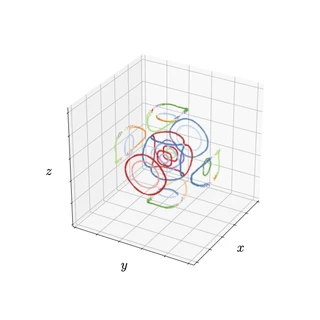 Image credit: Unsplash
Abstract
In a galactic halo like the Milky Way, bosonic dark matter particles lighter than about 100 eV have a de Broglie wavelength larger than the average inter-particle separation and are therefore well described as a set of classical waves. This applies to, for instance, the QCD axion as well as to lighter axion-like particles such as fuzzy dark matter. We show that the interference of waves inside a halo inevitably leads to vortices, locations where chance destructive interference takes the density to zero. The phase of the wavefunction has non-trivial winding around these points. This can be interpreted as a non-zero velocity circulation, so that vortices are sites where the fluid velocity has a non-vanishing curl. Using analytic arguments and numerical simulations, we study the properties of vortices and show they have a number of universal features: (1) In three spatial dimensions, the generic defects take the form of vortex rings. (2) On average there is about one vortex ring per de Broglie volume and (3) generically only single winding (± 1) vortices are found in a realistic halo. (4) The density near a vortex scales as r2 while the velocity goes as 1/r, where r is the distance to vortex. (5) A vortex segment moves at a velocity inversely proportional to its curvature scale so that smaller vortex rings move faster, allowing momentary motion exceeding escape velocity. We discuss observational/experimental signatures from vortices and, more broadly, wave interference. In the ultra-light regime, gravitational lensing by interference substructures leads to flux anomalies of 5-10 % in strongly lensed systems. For QCD axions, vortices lead to a diminished signal in some detection experiments but not in others. We advocate the measurement of correlation functions by axion detection experiments as a way to probe and capitalize on the expected interference substructures.
Type
Publication
Journal of Cosmology and Astroparticle Physics

Authors
Assistant Professor
Xinyu Li is an assistant professor in the Department of Astronomy, Tsinghua University. He is fond of discovering fundamental physical laws from the vast observation of various astrophysical objects. His research areas are high energy astrophysics, plasma astrophysics and cosmology. His research topics cover a broad range of physical scales: from the smallest fundamental particles like electrons and ultralight axions, to neutron stars, black holes and galaxies, and to the largest scale structure of the universe.