Electromagnetic Signatures of Supermassive Binary Black Holes. I. Thermal Synchrotron, Self-Lensing Flares, and Jet Precession
March 1, 2026· ,,,·
0 min read
,,,·
0 min read
Hong-Xuan Jiang
Xinyu Li
Yosuke Mizuno
Ziri Younsi
Christian Fromm
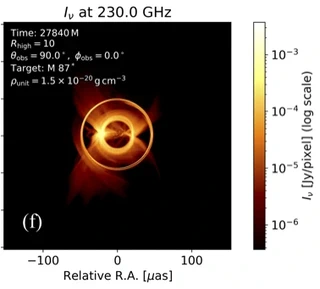 Image credit: Hong-Xuan Jiang
Abstract
The recent evidence for a nanohertz gravitational wave background from Pulsar Timing Arrays highlights the urgent need to identify electromagnetic counterparts to supermassive binary black holes. Here, we perform global 3D general relativistic magnetohydrodynamic (GRMHD) simulations of a secondary black hole (mass ratio q=0.1) interacting with a Magnetically Arrested Disk around a primary black hole using a time-dependent superposed Kerr-Schild metric and post-processed general relativistic radiation transfer calculations based on thermal electron distribution function (eDF). We explore three orbital configurations: a vertical impact orbit, a coplanar embedded orbit, and a high-spin, eccentric, inclined scenario. Despite clear orbital periodicity and recurrent shock formation, the thermal synchrotron light curves frequently lack expected shock-induced flares. In vertical impacts, shock brightenings are typically sub-dominant to the stochastic MAD variability of the primary black hole, unless viewed at specific alignment phases. Conversely, coplanar orbits produce distinctive, rapid flares driven by gravitational self-lensing. We identify a frequency-dependent emission hierarchy: the primary black hole dominates sub-millimeter flux, while the secondary dominates near-infrared emission due to higher electron temperatures in thermal eDF. Finally, spin-orbit coupling drives Lense-Thirring precession, yielding twisted, wobbling jets reminiscent of OJ~287. Crucially, we demonstrate that intrinsic MAD turbulence may easily mask shock-induced flares at radio frequencies. We strongly advocate coordinated sub-millimeter and near-infrared monitoring to robustly isolate supermassive binary black hole self-lensing signatures.
Type
Publication
Journal Name

Authors
Assistant Professor
Xinyu Li is an assistant professor in the Department of Astronomy, Tsinghua University. He is fond of discovering fundamental physical laws from the vast observation of various astrophysical objects. His research areas are high energy astrophysics, plasma astrophysics and cosmology. His research topics cover a broad range of physical scales: from the smallest fundamental particles like electrons and ultralight axions, to neutron stars, black holes and galaxies, and to the largest scale structure of the universe.