Black Hole Collisions with Thin Accretion Disks: OJ 287 and Small Mass Ratio Supermassive Black Hole Binary Candidates

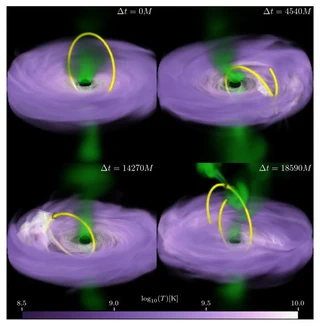 Image credit: Sean Ressler
Abstract
OJ 287 is the best-known supermassive black hole binary candidate in the nanohertz gravitational-wave band. It exhibits periodic flares every ∼12 yr, likely caused by collisions of a lower-mass secondary with the accretion disk surrounding a higher-mass primary. It is therefore an important benchmark for understanding black hole binary accretion in the approaching era of space-based gravitational-wave detectors and large electromagnetic surveys. Because the electromagnetic emission of the system is determined by a complex interplay of plasma, accretion, and radiation physics in strong gravity, numerical simulations are required for realistic modeling. We present the first global, three-dimensional, general relativistic magnetohydrodynamic simulations of OJ 287─like systems, namely lower-mass secondaries colliding with a radiatively cooled (thin) disk surrounding a higher-mass primary. We focus on disks with scale heights that are 10% of the distance from the primary and binary mass ratios of q = 0.1, 0.05, and 0.025 using an optically thin cooling prescription. We confirm the basic paradigm that impacts of the secondary on the disk can generate enough power to outshine the quiescent emission. The secondary also causes spiral shocks to form in the disk, enhanced accretion events, overall heating of the flow, and stochastic tilting of the disk, though these effects are small for q < 0.05. Our results can be extrapolated to the parameters of OJ 287 and similar systems, an important step on the path toward fully realistic simulations of accretion onto small mass ratio black hole binaries and predicting electromagnetic counterparts to low-frequency gravitational-wave detections.
Type
Publication
The Astrophysical Journal Letters

Authors
Assistant Professor
Xinyu Li is an assistant professor in the Department of Astronomy, Tsinghua University. He is fond of discovering fundamental physical laws from the vast observation of various astrophysical objects. His research areas are high energy astrophysics, plasma astrophysics and cosmology. His research topics cover a broad range of physical scales: from the smallest fundamental particles like electrons and ultralight axions, to neutron stars, black holes and galaxies, and to the largest scale structure of the universe.