
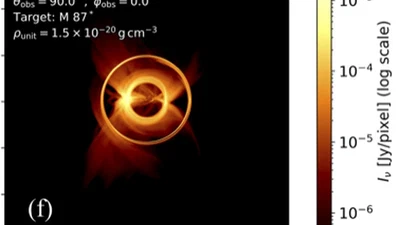
Electromagnetic Signatures of Supermassive Binary Black Holes. I. Thermal Synchrotron, Self-Lensing Flares, and Jet Precession
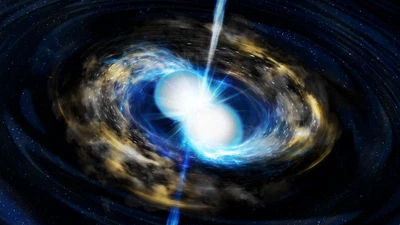
First image of supermassive black hole binary.
hong-xuan-jiang
PhD Physics
2013-9
2019-9
Columbia University
MS Theoretical Physics
2012-9
2013-6
Perimeter Institute
BS Physics and Mathematics
2008-9
2012-6
University of Hong Kong
I am a theoretical physicist, eager to learn about the laws of nature.
I apply various quantitative methods to comprehensively investigate how fundamental physics laws that governs the motion of subatomic particles can shape our universe.
I write code to reproduce the cosmos on huge computer clusters —- a world model not driven by data, but from physics.
I am curious to learn and explore the world beyond my main research area. How to build world model from physics for AI? How patterns merge in complex systems?
Please feel free to contact me if you would like to chat and collaborate 😃
First image of supermassive black hole binary.
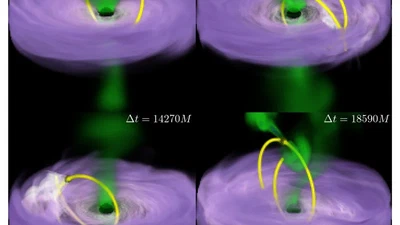
The first ever global simulation of OJ-287 where a companion black hole collides with the disk of the central black hole.
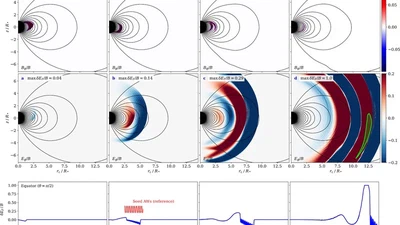
How waves interact in the magnetar magnetosphere?
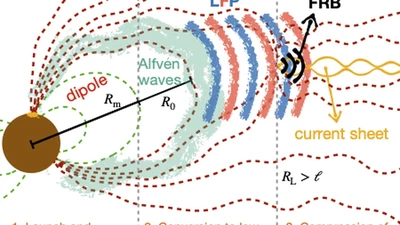
A new theory of Fast Radio Burst.
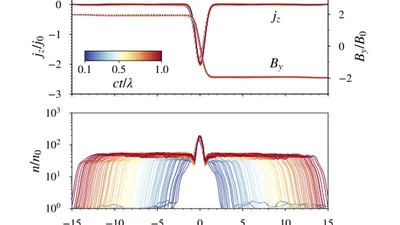
A new channel of fast magnetic energy dissipation.

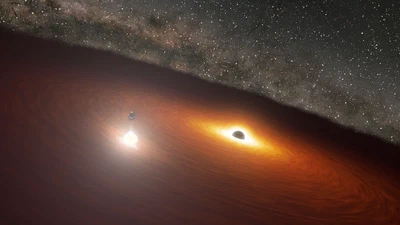
What can we learn from GRMHD simulations?
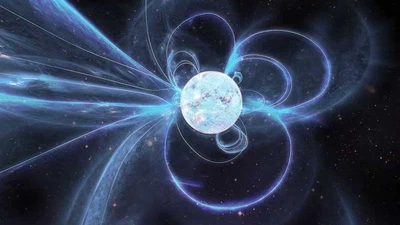
How Alfven wave dynamics can power Fast Radio Burst?
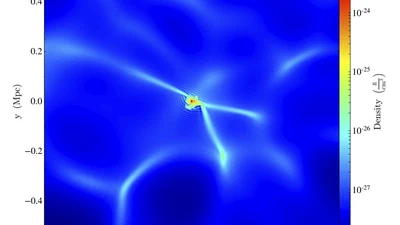
Numerical study of Fuzzy Dark Matter model.
Neutrino fast flavour conversion
The fluid equations in the conservative form are $$\begin{aligned} \partial_t \rho +\nabla\cdot(\rho \boldsymbol{u})&=&0 \\ \partial_t (\rho u^i)+\nabla\cdot(\rho …
In the formulation of Elsasser’s variables $\mathbf{U} = \mathbf{v}+\mathbf{b}$ and $\mathbf{W} = \mathbf{v}-\mathbf{b}$, $$\begin{aligned} &&\partial_t \mathbf{U} = …
In relativistic MHD, the magnetic field 4-vector $b_\mu$ and electric field $e_\mu$ in the fluid frame is defined through the 4-vector $u^{\mu}$ and EM 2-form $F_{\mu\nu}$.
Consider the ideal incompressible MHD wave governed by the equations $$\begin{aligned} \frac{\partial \vec{v}}{\partial t}+\vec{v}\cdot \nabla\vec{v}&=&\vec{B}\cdot\nabla\vec{B}\\ …
Particle Motion in Uniform Perpendicular Electromagnetic Fields A test particle with mass $m$ and charge $q$ moving at velocity $\boldsymbol{v}$ in an electromagnetic field feels …
The energy momentum tensor for a relativistic pressureless fluid is $$T^{\mu\nu} = (\rho h + \frac{b^2}{4\pi})u^\mu u^\nu + \frac{b^2}{8\pi}g^{\mu\nu} - \frac{b^\mu …